
What privacy actually means for stablecoin issuers
Public ledgers expose too much, permanently. Regulated finance needs confidentiality by default and auditability on demand.

Most people hear “privacy on blockchain” and think of mixers, untraceable flows, and money laundering. That association is understandable. For years, privacy in crypto meant hiding everything.
Regulated finance needs something different. Institutions need confidentiality by default, and auditability when it is required. Modern cryptography, especially selective disclosure, makes that possible.
Public ledgers leak too much, forever
On Ethereum-style ledgers, all information needed for verification is public. Addresses are pseudonyms, but activity patterns reveal counterparties, flows, and business relationships.
That is a dealbreaker for regulated actors. Treasury flows, inventory, client lists, and operating patterns cannot be public signals.
Privacy, in this context, is not about escaping oversight. It is about removing public leakage while keeping verification and compliance intact.
Confidentiality, anonymity, privacy: what regulated finance actually needs
To align on what “privacy” means in this post, let’s borrow DBA’s terminology matrix and the distinctions it makes.
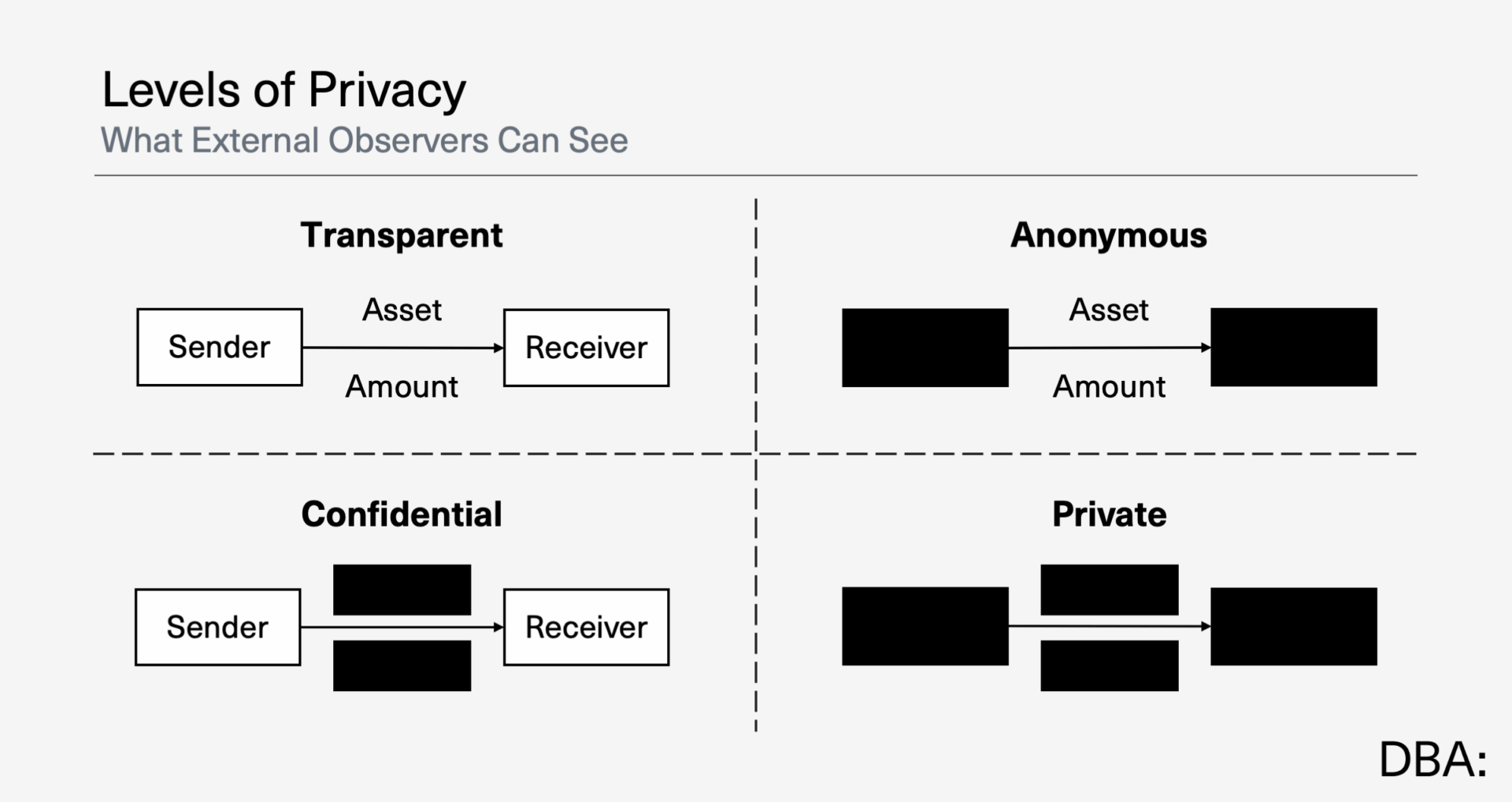
The key point for regulated finance is this:
- Anonymity tries to remove traceability.
- Confidentiality reduces who can see sensitive data.
- Privacy for regulated finance should be private by default and traceable on-demand.
In other words, information is not public, but it can be disclosed to authorized parties when needed.
What stablecoin issuers actually need
Regulated actors cannot aim for anonymity. They need to be able to demonstrate and enforce things like KYC and KYB completion, sanctions screening, eligibility constraints, transaction limits, and audit trails.
The real question is not how to hide transactions anymore, but how to control visibility while keeping compliance provable.
A regulated privacy system should be optimized for three outcomes:
- Privacy protects market participants. Sensitive business data should not be a public good.
- Proofs preserve shared verification. The system should remain verifiable without relying on trust.
- Selective disclosure enables compliant audits. Authorized parties can see what they need, and only what they need.
Under MiCA and GDPR, European regulated actors face explicit obligations around data minimization and audit trails.
Selective disclosure: privacy by default, auditability when required
Selective disclosure lets you prove compliance facts without revealing all underlying transaction data.
In practice, this means a transaction can remain confidential to the public, while still being verifiable by the network, and auditable by the relevant authorized parties under a defined disclosure process.
We covered this in more detail in this blog post:
 Alex Sirac
Granular confidentiality, contract by contract
One important requirement for institutions is granularity. Not every operation needs the same visibility.
With a selective disclosure model:
- Some transactions can be public.
- Some transactions can be confidential.
- Disclosure policies can vary by application or smart contract.
The result is a system where each institution can configure privacy features to match its risk, compliance, and operational needs, without forcing everything into a single “all public” or “all hidden” mode.
If your institution is exploring confidential transactions on regulated infrastructure, let’s schedule a call to walk through how Hyli approaches selective disclosure.