
2025 in review at Hyli
In 2024, we built our first proofs of concepts and prototypes; in 2025, we refined our model and took it to the next level.


Hyli’s mission is to turn compliance and privacy into protocol-level primitives for tokenized finance. We leverage the latest innovations in decentralized computing and zero-knowledge systems to enable performant, private and compliant blockchain applications.
In a bit more than eighteen months, we shipped an entire blockchain client from scratch, the first implementation of the Autobahn consensus algorithm, EVM compatibility, a fully provable order book and a testnet which broke all records for production usage of zkVMs and proving networks.
There was no blueprint for what we wanted to build, so we marched on and did it anyways. Let’s look back together on a foundational year for Hyli.
Our journey in 2025
New year, new us?
In 2025, we changed quite a lot of things about our identity!
First, in February, we moved to bigger, brighter, more orange offices, still in the heart of Paris.
And then, in May, we conducted a full rebrand: same sound, same mission, still orange… but a new name and a new visual identity, bringing us from Hylé to Hyli. The main change was moving our æsthetics from fun retrofuturistic images to the monumental design you have come to know and love.
 Sylve Chevet
We launched a demo testnet
During the summer, we launched a demo testnet for Hyli.
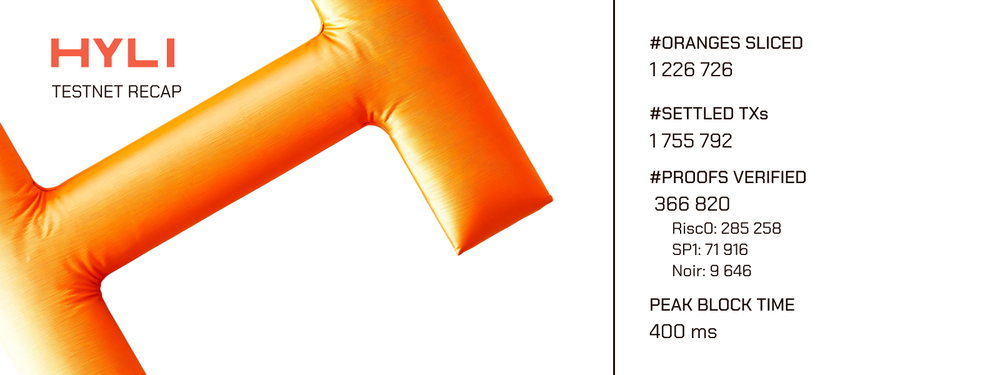
We created 6 demo applications: a wallet, an explorer, and fully onchain minigames that got a lot of success! Some of you will fondly remember Faucet Ninja (our orange-slicing faucet minigame) and the Orange Trail board game!
Everything was production-grade, generating real proofs and settling them on the Hyli testnet. For this, we used three proving schemes: the client-side and private Noir, as well as SP1 and Risc0, for which we partnered with the Succinct and Boundless proving networks.
While creating our testnet, we built a ready-to-use app scaffold for all developers to fork and play around with, making our developer experience easier than ever. We also stress-tested our infrastructure in real-world conditions, learning a lot from the experience and designing new patterns to maximize scalability for verifiable applications.
 Alex Sirac
We built and shipped
This was a busy year. We’ve mentioned the app scaffold above, but it was far from the only thing we built in terms of developer tooling: the Hyli wallet includes many more integrations than it did last year, including Metamask, and we are beta-ing the Hylix testing suite.
Hyli focuses on native proof verification, and keeps doing so. In 2025, we built two new native verifiers for our tools: one of them is for the mobile-first client-side proving scheme Cairo-M, and the other is for reth, which made Hyli fully EVM-compatible!
 Alex Sirac
We also built demos even outside of the open testnet period, for instance open-sourcing the code to Hyliquid, a fast, non-custodial private exchange.
 Alex Sirac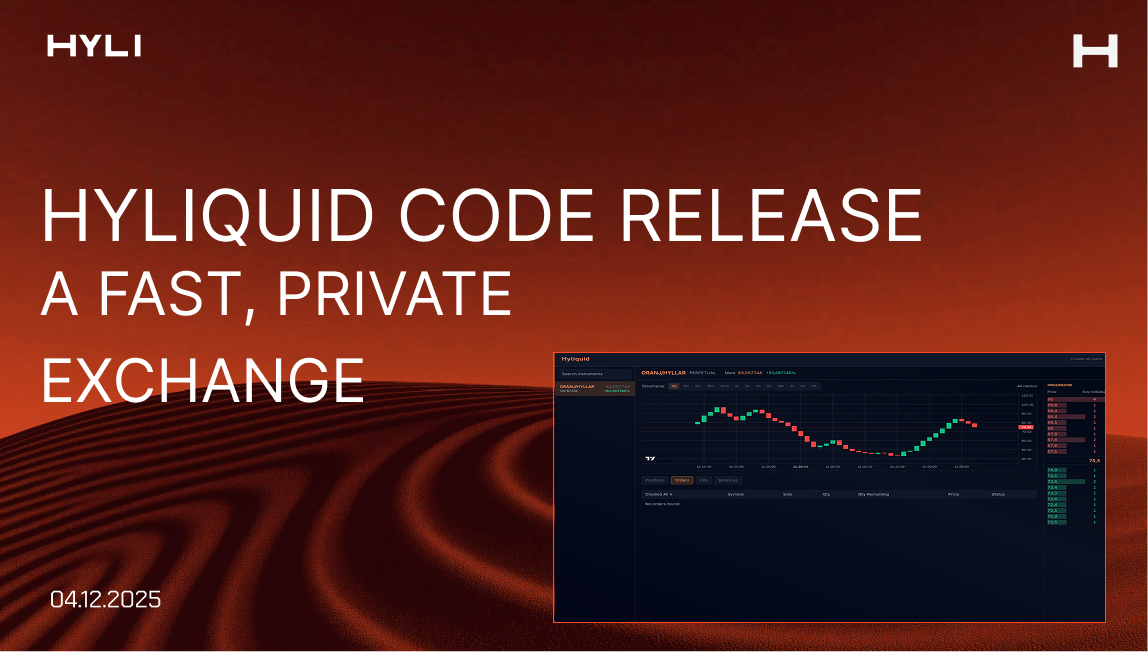
We advanced client-side proving research
As part of our partnership with Kakarot (now acquired by Zama), we built a mobile game based on the Cairo-M proving scheme.
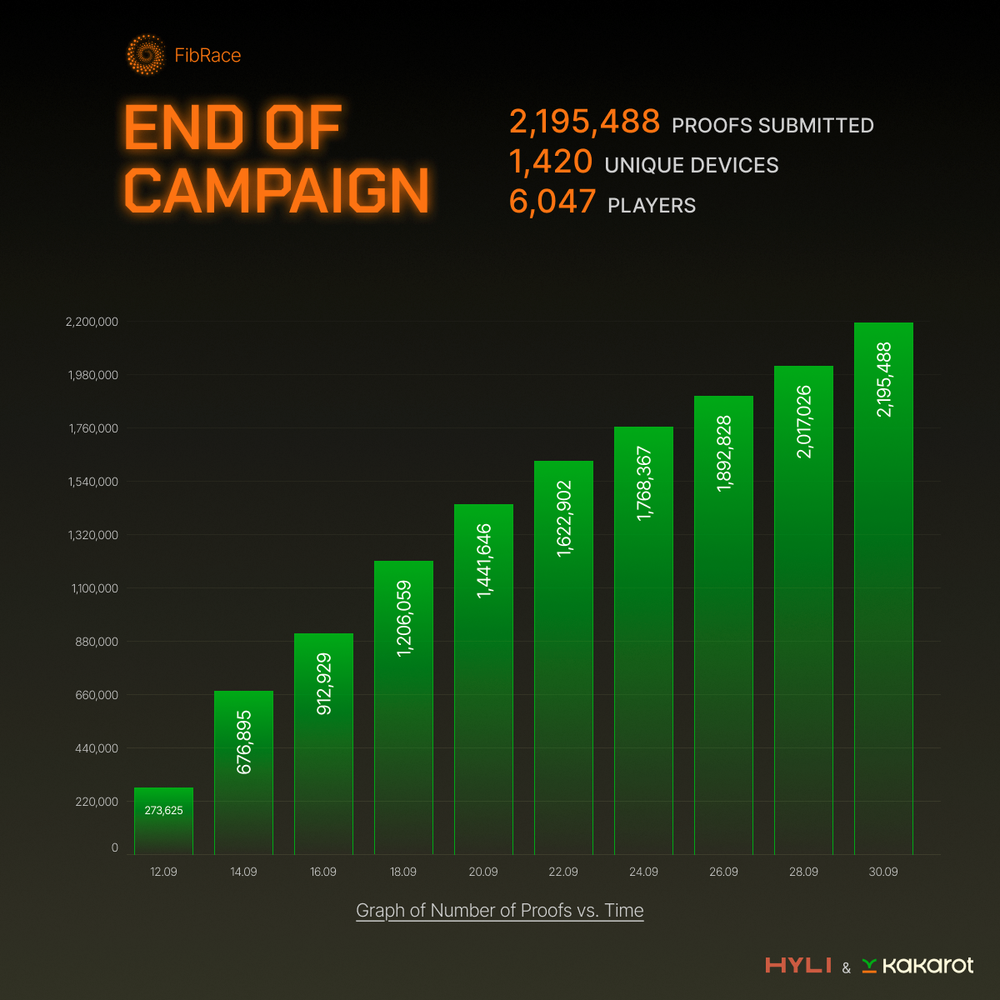
Over six thousand people took part in the first ever large-scale benchmark of client-side proving on mobile devices, generating more than two million proofs on their phones in just three weeks!
 Alex Sirac
We traveled and got down to business

Of course, if you’re on the conference circuit, you probably have met us: we were at ETH Denver, Berlin Blockchain Week (including ZuBerlin), ETHCC and DevConnect. At all of these events, we got wonderful speaking opportunities, organized morning coffees, and hosted coworking spaces for those who wanted to connect in low-key, productive environments.
We also took part in more builder-oriented projects: we were invited to a hackathon at the Lausanne EPFL, then attended the famed ETHaly. Our developer Matteo attended a Paradigm hackathon where he developed a proof of concept for prediction markets directly in Telegram chats.
Finally, we partnered up with Boundless for ZK Hack Berlin: the winner turned a standard credit card signature into a zero-knowledge proof without revealing sensitive data. Impressive!
Have you heard of zkEMV?
— Hyli (@hyli_org) September 4, 2025
At @__zkhack__ Berlin 2025, @mrnerdhair leveraged Hyli and @boundless_xyz to turn a standard credit card signature into a zero-knowledge proof without revealing sensitive data!
Learn more about this project: pic.twitter.com/9GblwK6Hii
Sometimes, we also stayed at home too. And « at home », in our case, means Paris. Sylve decided to share the magic with our community, shooting five Hyli explainers in some of the most beautiful spots of our city. If you missed them, now’s the perfect time to catch up!
We got new partners
Finally, in 2025, we kept confirming great partnerships.
During our public testnet phase, we collaborated with Succinct and Boundless. We then built FibRace together with Kakarot, which is now under the Zama umbrella. And we were proud to work hand in hand with Nexus, Fermah, and Zerobase!
A letter from our CEO and co-founder, Sylve
When I joined the blockchain industry in 2018, we could only dream about the level of adoption and advances we have now: what was once a niche piece of technology restricted to a few believers is now adopted by financial institutions and fintechs, exemplified by the growing adoption of stablecoins. The underlying technology has reached a point where developers can wield powers once reserved for a handful of researchers.
But obstacles still remain. The current programmable blockchain paradigm was invented more than a decade ago and requirements around performance, privacy and compliance cannot be solved with incremental changes, but by a bold, fundamental rethinking of how blockchains work. Every revolutionary technology is first grafted onto existing systems, then properly accounted for and unleashed with dedicated infrastructure. The Internet, born on restrictive phone landlines, now runs on purpose-built fiber optic networks. Bringing about this architectural change for blockchain is Hyli’s mission.
This infrastructure inversion, borrowing a concept from Andreas Antonopoulos, has happened to many technologies: the automobile, the Internet, and even the cinema. Marcel Pagnol, in Cinématurgie de Paris, lays out this exact dynamic on the emergence of talking movies. Few people saw how revolutionary they were in their mumbling beginnings, clumsily mimicking theater plays, forever in the shadow of silent cinema. After meeting studio executives who tried to talk him out of directing talking movies, Pagnol chose action over resignation: “They do not understand, or they are pretending not to understand. Instead of laying out my ideas, I would do better to put them into practice. I must make a film, after studying the technique of this art. No one can teach it to me, since no one knows it. I must think, and then take action.”
To another year of thinking and building the future, soon on Hyli’s mainnet,
Sylve